


Learning by Living
At IPLA, scholars don't just learn about the world — they practice living in it. Our classrooms are small enough that every scholar is known, our curriculum is strong enough to accelerate the ones who are ready, and our days are built so that curiosity, character and academic rigor grow together rather than competing.
Preschool — Age 3 to Pre-K

Our youngest scholars learn through play, because that's how young children learn best. A structured curriculum supports cognitive, social and emotional development while small class sizes and individualized attention let our teachers meet each child where they are. The result is a child who arrives at kindergarten not just prepared, but eager.
VPK

Our VPK program prepares children for kindergarten across every dimension that matters — social, emotional, cognitive and physical. VPK scholars are encouraged to explore, question and discover, building the habits of a curious mind before formal schooling begins.
Kindergarten – 2nd Grade

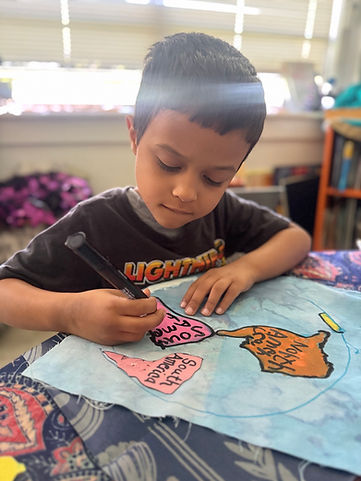
These are the foundation years. Scholars learn to read, write and reason with number, supported by explicit, research-based instruction and teachers who know exactly where each child stands. Interactive lessons and hands-on activities keep the work engaging; personalized attention keeps anyone from falling behind quietly.
3rd – 5th Grade

These are the years when a scholar stops being taught how to learn and starts doing it. The work gets longer, the thinking gets harder, and the responsibility shifts steadily onto them — on purpose.
Scholars move from reading to learn instead of learning to read, taking on longer texts and defending their thinking in writing. In math, they build fluency into real reasoning: multi-step problems, fractions, early algebraic thinking, and the ability to explain why an answer works, not just produce it. Across every subject, they research, plan, revise and present — because the skill that carries a child through middle school isn't recall, it's the ability to hold a hard problem without giving up on it.
This is also where our scholars lead. Upper-grade scholars anchor their houses, mentor younger scholars, and take on responsibility across the school. It's the difference between being told you're a leader and being handed something that requires it.
Because our classes are small and our curriculum is ours to shape, a scholar who is ready to move faster does. Acceleration is not an exception here — it's the reason IPLA exists.
Ready for what's next.
Our fifth graders leave prepared for the middle schools they choose, academically and personally. We work with families throughout the year on placement, applications and the transition ahead, so that no scholar walks into 6th grade unprepared for what's expected of them.
Our curriculum
IPLA teaches with Eureka Math², Amplify CKLA, UFLI Foundations, the same research-based programs used by high-performing schools across the country. We chose them because they work, and because they give our teachers the structure to accelerate a scholar who is ready to move faster.
Beyond the core
Art, music, physical education and Spanish are part of every scholar's week, not extras that get cut. Scholars also build the skills that don't appear on a report card — teamwork, communication, problem-solving, entrepreneurship and creative thinking.
Character and community
Our day begins together at Morning Convocation. Every K–5 scholar belongs to one of four houses, earning points for kindness, courage, effort and academic achievement. Character isn't something we hope happens here — it's taught, practiced and celebrated.
[Explore the IPLA House System →]
After school
After School — 3:30 to 5:00 PM
The school day ends at 3:00. The learning doesn't.Every IPLA scholar is welcome in our after-school program
Monday through Friday, 3:30 to 5:00 PM. Scholars rotate through activities designed to build the whole child, not just fill the hours.
Study Hall — Homework support and independent reading, with a teacher on hand. Most scholars head home with the work already done.
Music — Rhythm, voice and instruments. Scholars learn to make something together.
Movement — Time outside to run, play and reset after a full day of thinking.
Salon — Grooming, self-care and presentation, taught as a life skill and a form of self-respect.
Etiquette — How to introduce yourself, set a table, hold a conversation, write a thank-you note. The skills that open doors quietly.
Salon and etiquette are exactly what we mean by Learning by Living. Our scholars leave IPLA prepared for the classroom and for the room.
How we measure growth
You will never be surprised by your scholar's progress.Small classes mean our teachers see growth daily. But belief isn't evidence, so we measure — carefully, and often enough to do something about what we find.
NWEA MAP Growth, three times a year.
Our scholars take the MAP Growth assessment in reading and math each fall, winter and spring. MAP is adaptive: it adjusts as a scholar works, so it shows exactly where a child stands — including when they're working well above grade level. Because schools nationwide use it, your scholar's growth is measured against a national picture, not just our own classrooms.
Early literacy screening
Our youngest scholars are screened with Star Literacy, so that reading difficulties are caught early, while they're most fixable.
Everyday checks in the classroom
Teachers use day to day — exit tickets, running records, unit assessments.
Three parent-teacher conferences a year,
Following each MAP window, where a teacher walks you through your scholar's MAP report in person — not a printout in a backpack, but a conversation about what the data means and what happens next. You take the report home with you.
Quarterly report cards, with interim progress reports in between, so a full quarter never passes without an update.
A conference whenever it's needed. If a teacher sees something worth discussing, you'll hear from us. If you have a question, you don't wait for the calendar.
What we do with it. Assessment data doesn't get filed away. It tells us who needs a different approach, who needs more support, and who is ready to move faster — which is precisely why we built a curriculum we can accelerate. A scholar who's ready doesn't wait for the rest of the class to arrive.